September 5, 2024
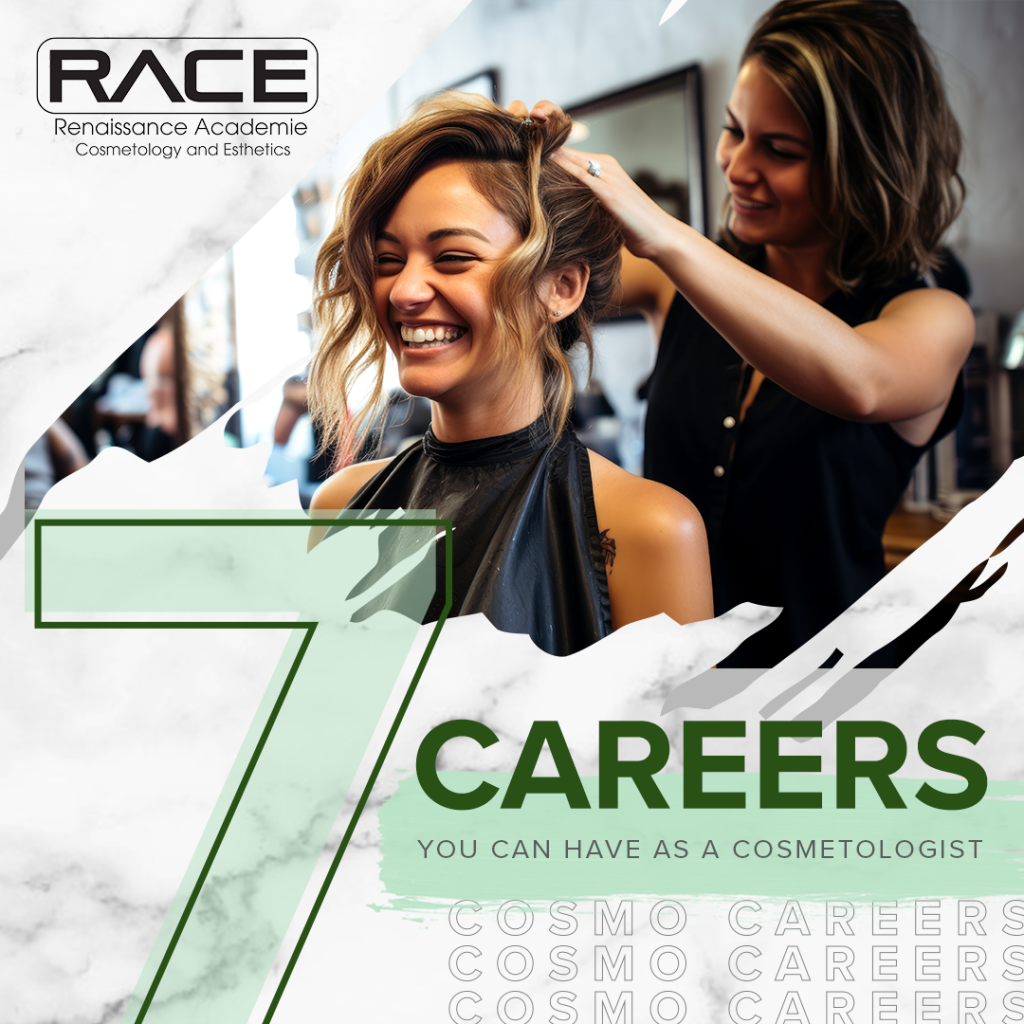
7 Cosmetology Career Paths to Explore in Utah
Last reviewed: August 2026
If you love hair, beauty, creativity, and working directly with people, Cosmetology can provide a broad professional foundation.
Utah’s Cosmetology licensing structure changed in 2026. For students entering the current school-based pathway, the required education is now 1,250 hours.
At Renaissance Academie (RACE) in Provo, Utah, Cosmetology students receive extensive professional hair education along with training in additional beauty disciplines such as nails, foundational skincare, makeup, manual hair removal, and barbering.
That broad education means graduates may eventually explore several different professional directions.
Here are seven Cosmetology career paths worth considering.
What Can a Utah Cosmetologist Do?
Before exploring career options, it helps to understand the professional scope behind the license.
Utah’s current Cosmetology pathway includes education in:
- Barbering
- Haircutting
- Chemical hair services
- Manual hair removal
- Basic esthetics
- Nail technology
- Certain eyelash and eyebrow services
A Utah Cosmetology license holder may also be known professionally as a cosmetologist or barber.
That gives Cosmetology students exposure to a wider group of beauty services than a program focused only on one specialty.
The exact services you perform professionally will depend on your license, employer, work environment, experience, interests, and applicable Utah requirements.
1. Hairstylist
One of the most common career directions for Cosmetology graduates is professional hairstyling.
A hairstylist may provide services such as:
- Haircutting
- Blowouts
- Styling
- Shampooing and conditioning
- Thermal styling
- Formal styles
- Client consultation
- Hair and scalp services
Successful stylists do more than create a finished look.
They also learn how to:
- Communicate with clients
- Understand lifestyle and maintenance needs
- Recommend appropriate services
- Manage appointment time
- Rebook clients
- Maintain sanitation
- Build professional relationships
For many professionals, hairstyling becomes the foundation of a long-term salon career.
2. Hair Color or Blonding Specialist
Some cosmetologists discover that color is the part of hair they love most.
A color-focused professional may eventually specialize in services such as:
- Permanent color
- Demi-permanent color
- Highlights
- Blonding
- Dimensional color
- Gray coverage
- Color correction
- Toners and glosses
- Creative color
Hair color requires a combination of creativity and technical knowledge.
Professionals need to understand concepts involving:
- Color theory
- Formulation
- Hair structure
- Developer strength
- Porosity
- Lightening
- Underlying pigment
- Chemical safety
- Consultation
Specializing usually develops over time through education, repetition, experience, and continuing professional development.
3. Barbering-Focused Cosmetologist
You do not have to choose a limited barbering pathway to make barbering a major part of your professional career.
Utah’s current Cosmetology curriculum includes barbering and haircutting.
A cosmetologist may develop skills in areas such as:
- Clipper cutting
- Fades
- Tapered cuts
- Precision cutting
- Shaving
- Beard design
- Short hairstyles
- Grooming services
This is particularly valuable for someone who enjoys barbering but also wants education in services such as:
- Hair color
- Blonding
- Chemical texture
- Nails
- Skincare fundamentals
Utah also offers a separate 130-hour Barbering Permit, but that permit has a much narrower professional scope.
RACE focuses on comprehensive professional licensing pathways rather than permit-only training.
4. Full-Service Salon Professional
Some cosmetologists enjoy having variety in their day rather than specializing in only one service.
Because Utah’s Cosmetology scope is broad, a professional may develop a salon career that combines several areas of beauty.
Depending on training, experience, employer, and professional scope, that could include combinations of:
- Haircutting
- Hair color
- Styling
- Barbering
- Manicuring
- Makeup
- Basic skincare services
- Manual hair removal
- Brow services
A broader service background can also help a cosmetologist determine which area they eventually want to specialize in.
Some students enter Cosmetology because they already know exactly what they want to do.
Others choose it because they want the opportunity to explore several parts of beauty before narrowing their focus.
5. Independent Professional or Salon Owner
Some cosmetologists eventually decide they want to operate independently or build a beauty business.
Depending on applicable licensing and business requirements, professionals may explore environments such as:
- Salon suites
- Booth rental
- Independent studios
- Full-service salons
- Barbering-focused businesses
Owning a business requires much more than technical skill.
Professionals may also need to understand:
- Business licensing
- Facility requirements
- Insurance
- Taxes
- Scheduling
- Pricing
- Inventory
- Retail
- Marketing
- Social media
- Client retention
- Customer service
- Staff management
- Utah professional regulations
A Cosmetology license does not automatically satisfy every requirement for operating a salon or other beauty business.
Professional licensure, establishment requirements, local business requirements, and business ownership are separate considerations.
6. Cosmetology Instructor or Beauty Educator
Some professionals eventually discover that they enjoy teaching as much as performing services.
Possible education-related directions can include:
- Licensed beauty-school instruction
- Product education
- Technical workshops
- Brand education
- Continuing professional education
However, a Cosmetology license alone does not automatically qualify someone to teach students in a licensed Utah beauty school.
Under current Utah law, an applicant for an instructor license must hold the applicable professional license or permit, document six months of work experience in the discipline they intend to teach, complete either a 75-clock-hour instructor training program or 75-clock-hour on-the-job instructor training program, and satisfy the examination requirement established by DOPL rule.
Instructor licensing is therefore a later professional step—not something automatically received at Cosmetology graduation.
Someone who loves mentoring, explaining techniques, and helping others develop may decide to pursue that path after gaining professional experience.
7. Brand Educator, Product Representative, or Beauty Content Professional
Not every career related to Cosmetology happens behind the salon chair.
Experienced beauty professionals may eventually explore opportunities with:
- Professional hair brands
- Beauty manufacturers
- Distributors
- Tool companies
- Product education teams
- Industry events
- Social-media platforms
- Beauty publications
Depending on the position, a professional might:
- Demonstrate products
- Train salon teams
- Create educational content
- Represent a professional brand
- Attend trade shows
- Develop tutorials
- Create social-media content
- Support professional accounts
- Review products
- Explain techniques
These careers are not guaranteed outcomes of Cosmetology school.
They often develop after someone has built professional skill, industry experience, communication ability, a portfolio, relationships, or an audience.
Beauty-school education can provide industry knowledge that someone may later use in these types of roles.
What About Makeup Artistry?
Cosmetology education can include professional makeup application.
Some professionals incorporate makeup into their beauty services, especially for:
- Weddings
- Special events
- Photography
- Formal occasions
- Salon clients
However, makeup careers vary widely.
Certain makeup work may not require a Cosmetology license, while other services performed alongside regulated beauty services may fall under professional licensing requirements.
Students primarily interested in makeup should consider the type of work they ultimately want to perform rather than assuming Cosmetology is required for every makeup career.
What About Nail Services?
Utah’s Cosmetology scope includes Nail Technology services.
That means Cosmetology students receive education beyond hair.
However, RACE also offers a separate 300-hour Nail Technology program for students who know nails are the specialty they want to focus on.
The distinction is similar to other RACE programs:
Cosmetology provides broader education.
Nail Technology provides focused nail education.
If your passion is clearly nails, the shorter specialty program may make more sense.
If you want professional hair plus exposure to nails, skincare, makeup, barbering, and other beauty disciplines, Cosmetology may be a stronger match.
Cosmetology vs. Hair Design: Which Is Better for Your Career Goals?
RACE currently offers two professional pathways with substantial hair education.
Cosmetology — 1,250 Hours
Cosmetology includes extensive hair education plus additional training in areas such as:
- Nails
- Basic skincare
- Makeup
- Manual hair removal
- Barbering
Hair Design — 1,000 Hours
Hair Design focuses on all things hair, including:
- Haircutting
- Barbering
- Color
- Blonding
- Chemical texture
- Styling
- Extensions
A simple way to think about it is:
If your passion is all things hair → explore Hair Design.
If you want hair plus broader beauty training → explore Cosmetology.
Neither program is automatically “better.”
The better program is the one that matches the services and professional flexibility you want.
How Long Is RACE Cosmetology?
Renaissance Academie’s current Cosmetology program requires:
1,250 total hours
The current hybrid structure combines:
810 hours of on-campus training
with
up to 440 hours of approved distance education.
Students can choose from several pacing options based on current availability and enrollment periods.
Estimated completion time depends on:
- Weekly schedule
- Attendance
- Academic progress
- Practical completion
- Required program hours
Prospective students should use the current Cosmetology program page for the most up-to-date scheduling information.
Is Financial Aid Available for RACE Cosmetology?
Federal Student Aid is available to those who qualify in eligible programs.
RACE’s Cosmetology program is currently an eligible program.
Individual student eligibility varies.
Students should work directly with RACE Financial Aid to understand:
- FAFSA requirements
- Grants
- Federal loans
- Scholarships
- Other financing options
- Personal balances
Completing the FAFSA does not guarantee a particular grant, loan, or aid package.
Does Cosmetology School Guarantee a Career?
No.
Beauty school can provide professional education, hands-on training, licensing preparation, and foundational business skills.
It cannot guarantee:
- Employment
- A particular employer
- A specific salary
- A certain clientele
- Business ownership
- Social-media success
- A particular career outcome
Professional success can depend on factors such as:
- Licensing
- Skill
- Attendance
- Experience
- Location
- Local demand
- Professional reputation
- Networking
- Client retention
- Continuing education
- Business ability
- Individual effort
A beauty-school program is the beginning of professional development—not the final destination.
What Happens After Cosmetology School?
Graduation and professional licensing are separate steps.
After completing the required education, graduates must satisfy the applicable Utah licensing requirements.
Current Utah law generally requires applicants to:
- Complete required education and service counts
- Submit the required application
- Pay applicable fees
- Satisfy the examination requirement established by DOPL rule
Testing processes and application requirements can change.
Students approaching graduation should rely on current Utah DOPL information and guidance from their school.
What If You Move to Another State?
A Utah Cosmetology license does not automatically authorize you to practice in every other state.
Professional beauty licensing is regulated at the state level.
If you relocate, another jurisdiction may evaluate factors such as:
- Your license
- School hours
- Curriculum
- Professional scope
- Examination history
- Experience
- Additional education
Some states may provide endorsement or reciprocity pathways, while others may require additional steps.
Students who know they may move should research the requirements of states where they may eventually practice.
Frequently Asked Questions
How many hours is Cosmetology school in Utah?
Utah’s current school-based Cosmetology pathway requires 1,250 hours.
How long is RACE Cosmetology?
RACE’s current program is 1,250 hours, combining 810 campus hours with up to 440 approved distance-education hours.
Does Utah Cosmetology include barbering?
Yes.
Utah’s Cosmetology curriculum includes barbering and haircutting, and state law allows a Cosmetology license holder to be known as a cosmetologist or barber.
Can a cosmetologist work in a barbershop?
Cosmetologists may pursue work environments that include barbering services, subject to their professional scope, employer requirements, and applicable regulations.
Can cosmetologists perform nail services?
Utah’s current Cosmetology scope includes Nail Technology services.
Can cosmetologists perform skincare services?
Utah Cosmetology includes foundational/basic esthetics services within the statutory Cosmetology scope. It does not provide the same advanced scope as a Master Esthetics license.
Can a cosmetologist become an instructor?
Yes, potentially—but instructor licensing is a separate process.
Current Utah law requires the applicable professional credential, six months of work experience, 75 hours of qualifying instructor training or on-the-job instructor training, and the examination requirement established by DOPL rule.
Does RACE still offer Cosmetology/Barbering?
RACE’s current program is called Cosmetology.
Older RACE materials may reference the former Cosmetology/Barbering program, but students entering under the current 2026 pathway should use current Cosmetology program information.
Is Cosmetology the same as Hair Design?
No.
Cosmetology is broader, while Hair Design focuses more specifically on professional hair services.
Explore Cosmetology at Renaissance Academie
If you want professional hair education plus exposure to barbering, nails, skincare, makeup, and other beauty disciplines, RACE’s 1,250-hour Cosmetology program may be worth exploring.
The current program combines:
810 hours of hands-on campus education
with
up to 440 hours of approved distance education.
Students develop professional beauty skills, work with clients under supervision, receive business and career education, and prepare for Utah’s Cosmetology licensing pathway.
Explore the Renaissance Academie Cosmetology Program for current curriculum, schedules, tuition, program costs, Financial Aid information, start dates, and enrollment requirements.
Or schedule a campus tour to visit RACE in Provo, explore the salon and classrooms, compare Cosmetology with Hair Design, and talk with Admissions about which path best matches your goals.
Career opportunities vary based on professional licensing, individual skill, experience, location, employer requirements, business setup, market conditions, and other factors. Completion of a beauty-school program does not guarantee employment, income, business ownership, or a particular career outcome. Licensing requirements may change and should be verified through Utah DOPL.