March 6, 2026
Utah’s 270-Hour Lash & Brow License: 2026 Guide
Last reviewed: August 2026
If you love lash artistry, brow design, precision work, and helping clients enhance their natural features, Utah now offers a focused professional licensing pathway specifically for lash and brow services.
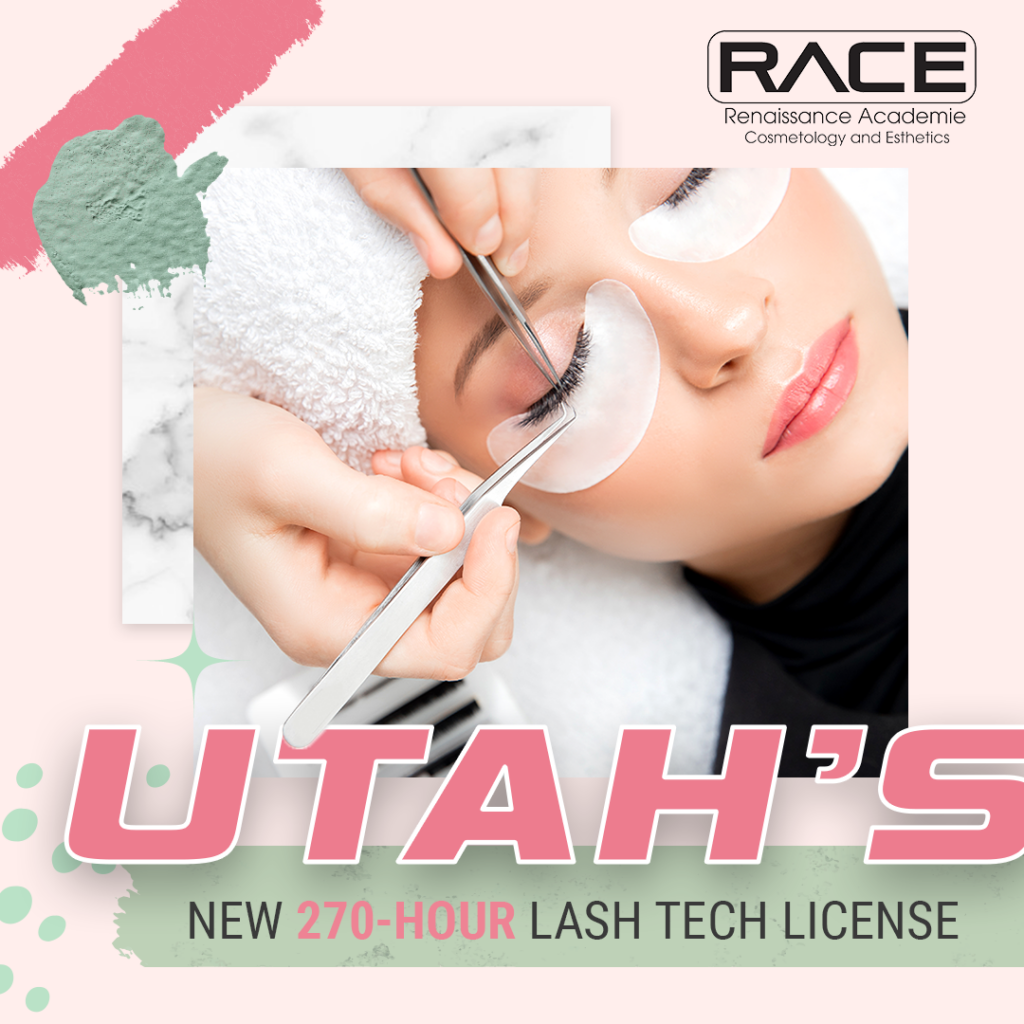
Beginning January 1, 2026, Utah’s Eyelash and Eyebrow Technology License requires a minimum of 270 hours of education through an eligible school pathway or completion of an approved apprenticeship.
At Renaissance Academie in Provo, Utah, our 270-hour Lash & Brow Technology program combines hands-on campus training, approved distance education, real-client experience, business education, and preparation for applicable Utah licensing requirements.
Here is what prospective students should know about Utah’s current Lash & Brow license.
What Is Utah’s 270-Hour Lash & Brow License?
Utah officially calls this credential the Eyelash and Eyebrow Technology License.
The license was created as part of Utah’s updated beauty-industry licensing structure and became effective January 1, 2026.
For students pursuing the school-based pathway, Utah requires a minimum of 270 hours of instruction in eyelash and eyebrow technology.
This is a professional license, not simply a short-course certificate.
That distinction matters because Utah law requires an individual practicing eyelash and eyebrow technology to hold the appropriate license unless a legal exemption applies.
What Services Are Included in Utah’s Lash & Brow Scope?
Utah law defines the practice of eyelash and eyebrow technology to include services such as:
- Eyebrow arching by tweezing or waxing
- Eyelash tinting
- Eyebrow tinting
- Facial waxing
- Lash perming and lifting
- Brow perming and lamination
- Eyelash extensions
- Eyebrow extensions
This means the Utah license is broader than simply applying lash extensions.
Students preparing for this profession need education in client safety, sanitation, consultation, lash services, brow services, chemical processes, and the professional responsibilities associated with working around the eyes and face.
Why Did Utah Create a 270-Hour License?
Lash and brow services require precision and can involve adhesives, chemicals, waxing products, and procedures performed very close to the eyes.
Utah’s licensing structure establishes a formal education pathway for professionals who want to specialize in these services.
The 270-hour requirement gives students time to develop more than one isolated technique.
Professional education can include:
- Infection control
- Sanitation
- Eye-area anatomy
- Contraindications
- Client consultation
- Product chemistry
- Lash application
- Lash removal
- Brow services
- Chemical services
- Client aftercare
- Professional ethics
- Business practices
- Licensing preparation
The goal is to help students build both technical skill and safe professional habits before entering the industry.
Step 1: Choose a Licensed Lash & Brow Technology Program
Students pursuing the school-based pathway need to complete an eligible 270-hour program.
When comparing schools, ask about:
- Hands-on training
- Instructor support
- Lash-extension techniques
- Brow education
- Lash lifts and brow lamination
- Safety and sanitation
- Real-client experience
- Distance-education options
- Schedule
- Licensing preparation
- Student kit and products
- Business and marketing education
- Total program cost
Renaissance Academie offers its 270-hour Lash & Brow Technology program at our campus in Provo, Utah.
Step 2: Complete 270 Hours of Education
RACE’s Lash & Brow Technology program is 270 total hours.
The current program includes:
- 190 hours of hands-on campus training
- 80 hours of approved distance education
On-campus classes currently meet Tuesday through Thursday from 4:00–8:00 PM.
The program is designed to combine flexible academic learning with substantial practical experience.
Students must successfully complete all program requirements—not simply accumulate clock hours.
Step 3: Build Lash Artistry Skills
Lash education at RACE includes areas such as:
- Natural lash growth cycles
- Classic lash extensions
- Volume lash techniques
- Lash mapping
- Lash design
- Lash-extension application
- Lash lifts
- Lash tinting
- Client consultation
- Lash removal
- Client aftercare
Developing strong lash technique requires patience and repetition.
Students learn to consider factors such as natural-lash health, eye shape, styling goals, extension weight, placement, isolation, safety, and client comfort.
Step 4: Build Professional Brow Skills
Utah’s credential covers both lashes and brows, which is why RACE refers to the program as Lash & Brow Technology.
Brow education may include:
- Brow anatomy
- Skin considerations
- Brow mapping
- Brow shaping
- Brow tinting
- Brow lamination
- Client consultation
- Aftercare
- Safety and sanitation
Utah’s statutory scope also includes eyebrow tweezing or waxing and facial waxing.
Students should always perform services within the current scope of their license and the education and training they have received.
Step 5: Learn Safety, Sanitation, and Contraindications
Technical skill is only one part of professional lash and brow work.
Working near a client’s eyes requires careful attention to safety.
Students learn concepts such as:
- Infection control
- Cleaning and disinfection
- Professional sanitation
- Eye-area anatomy
- Allergies and sensitivities
- Contraindications
- Client protection
- Product safety
- Proper service setup
- Aftercare
- When a service should not be performed
A beautiful result is never more important than client safety.
Step 6: Gain Real-Client Experience
Practicing a technique during class is different from performing that service on an actual client.
RACE students have opportunities to provide applicable lash and brow services to real clients under professional supervision.
Client experience helps students develop:
- Consultation skills
- Professional communication
- Service timing
- Technical consistency
- Client comfort
- Problem-solving
- Aftercare education
- Rebooking habits
- Professional confidence
These experiences can help students prepare for the transition from school into the beauty industry.
Step 7: Learn Business and Client-Building Skills
Many lash and brow professionals eventually want to build their own clientele.
Technical ability is important, but professionals also need to understand how to create a strong client experience and build a sustainable business.
RACE incorporates professional and career education that may include:
- Client retention
- Professional consultation
- Service menus
- Pricing concepts
- Marketing fundamentals
- Social-media presence
- Professional photography
- Rebooking
- Customer service
- Business fundamentals
- Professional ethics
Your license gives you permission to practice within its scope.
Building a career requires additional professional skills.
Step 8: Prepare for Utah Licensing Requirements
Completing the 270-hour program is an important milestone, but graduation and professional licensure are separate steps.
Utah’s general licensing requirements include:
- Submitting the required application
- Paying the applicable fee
- Providing documentation of required education and service counts
- Satisfying any examination requirement established by DOPL rule
Testing providers, procedures, fees, and application requirements may change.
Students approaching graduation should use current information from the Utah Division of Professional Licensing (DOPL) and their school rather than relying on older online articles.
RACE incorporates licensing preparation into the student experience.
Can You Complete a Lash & Brow Apprenticeship Instead?
Utah law also allows an applicant to qualify through an approved eyelash and eyebrow apprenticeship.
That is a separate pathway from attending a licensed school.
Students considering an apprenticeship should review current DOPL registration, supervision, documentation, and completion requirements before choosing that route.
RACE provides the school-based 270-hour education pathway.
How Long Does RACE’s Lash & Brow Program Take?
RACE’s current Lash & Brow Technology program is 270 hours.
The current evening schedule combines approximately:
- 12 hours per week on campus
- 8 hours per week of approved distance education
- 20 total scheduled hours per week
Based on consistent attendance and successful completion of required coursework, the program can be completed in approximately 14 weeks.
Actual completion time may vary depending on attendance and completion of all academic and practical requirements.
Can Lash & Brow School Be Completed Online?
Not entirely.
RACE offers 80 hours of approved distance education, but the majority of the program is hands-on.
Students complete 190 hours of campus training where they can develop practical lash and brow skills, participate in demonstrations, receive instructor feedback, and gain supervised client experience.
Distance education adds flexibility without replacing practical training.
Is the Utah Lash & Brow Credential a License or a Permit?
It is a license.
Utah law refers to the credential as an Eyelash and Eyebrow Technology License.
That distinction is worth understanding, especially now that Utah uses both licenses and limited permits for different beauty professions.
RACE’s Lash & Brow Technology program prepares students for a professional licensing pathway rather than a permit-only pathway.
Can a Utah Lash & Brow License Be Used in Another State?
Do not assume that it can automatically transfer.
Beauty professions are regulated by individual states.
A Utah Eyelash and Eyebrow Technology License authorizes practice according to Utah law.
If you later move, the destination state decides:
- Whether it has an equivalent license
- Whether it recognizes Utah education
- Whether additional training is required
- Whether work experience can be considered
- Whether testing is required
- Whether another professional license is necessary
Some states may regulate lash services under esthetics or cosmetology rather than having a stand-alone lash and brow credential.
Students who expect to relocate should research the laws of any state where they may eventually practice.
What Is the Difference Between Licensing and Lash Certification?
A private lash certification and a Utah professional license are not necessarily the same thing.
A certification may show that someone completed training from a particular company, educator, or product brand.
A state license is the credential established by Utah law that authorizes someone to perform services within a legally defined scope.
Professional certifications can be useful for additional education, but students should not assume that a short certification course replaces Utah licensing requirements.
For someone intending to perform professional lash and brow services in Utah, understanding the legal licensing requirement is essential.
What Can You Do After Becoming Licensed?
Career opportunities depend on your individual skills, license, employer requirements, experience, business setup, and the services you perform.
Licensed Lash & Brow professionals may explore settings such as:
- Lash studios
- Brow studios
- Full-service salons
- Spas
- Specialty beauty businesses
- Independent studios where legally permitted
- Beauty bars
- Product or brand education after gaining appropriate experience
Some professionals focus primarily on lash extensions.
Others build service menus around a combination of lash lifts, tinting, brows, lamination, waxing, and other services permitted within their scope.
Can You Work Independently?
Potentially, but professional licensure is only one part of operating a business.
Someone planning to work independently should also research requirements related to:
- Business licensing
- Salon or facility licensing
- Local zoning
- Insurance
- Tax registration
- Sanitation requirements
- Professional products
- Recordkeeping
- Any applicable facility standards
Beauty-school education can introduce business fundamentals, but professionals remain responsible for complying with the laws applying to their specific business model.
Is Lash & Brow Technology Right for You?
This focused program may be a good fit if you:
- Love precision work
- Enjoy detailed services
- Are patient
- Like working one-on-one with clients
- Are interested in lash artistry
- Love brow design
- Want a specialized beauty path
- Want professional licensing education
- Like the idea of building a loyal clientele
- Prefer a shorter focused program rather than a broader beauty-school pathway
Lash and brow services require concentration and attention to detail.
For the right person, that precision can be exactly what makes the work enjoyable.
Why Consider RACE for Lash & Brow Technology?
Renaissance Academie offers a 270-hour Lash & Brow Technology program in Provo, Utah.
RACE students receive:
- 190 hours of hands-on campus education
- 80 hours of approved distance education
- Evening classes Tuesday–Thursday
- Lash-extension training
- Lash lift and tint education
- Brow shaping and mapping
- Brow tinting and lamination
- Safety and sanitation education
- Supervised real-client experience
- Business and career education
- State licensing preparation
RACE’s goal is not simply to help students complete 270 hours.
It is to use those hours to develop safe technique, professional confidence, client communication, business fundamentals, and preparation for what comes next.
Frequently Asked Questions
How many hours does it take to become a lash tech in Utah?
Utah’s school-based Eyelash and Eyrow Technology licensing pathway requires a minimum of 270 hours of instruction.
What is the official Utah lash license called?
Utah officially calls it the Eyelash and Eyebrow Technology License.
Does RACE offer a 270-hour Lash & Brow program?
Yes. Renaissance Academie offers a 270-hour Lash & Brow Technology program in Provo, Utah.
How is the RACE program divided?
RACE’s current program includes 190 hours of hands-on campus education and 80 hours of approved distance education.
Does the Utah license include brow services?
Yes. Utah’s scope includes both eyelash and eyebrow technology, including services such as brow shaping, tinting, waxing, and perming/lamination within the statutory scope.
Does the license include facial waxing?
Yes. Current Utah law includes facial waxing within the practice of eyelash and eyebrow technology.
Can Lash & Brow school be completed completely online?
No. RACE’s program includes approved distance education, but substantial hands-on campus training is required.
Can I qualify through an apprenticeship instead of school?
Utah law provides an approved apprenticeship pathway in addition to the school-based pathway. Prospective apprentices should verify current registration and completion requirements with DOPL.
Can a Utah Lash & Brow license automatically transfer to another state?
No. Each state determines whether and how it recognizes credentials earned elsewhere.
Start Your Lash & Brow Career at Renaissance Academie
If lash artistry, brow design, and detailed beauty work are where your interests are taking you, RACE’s focused 270-hour Lash & Brow Technology program may be the next step.
Explore the Renaissance Academie Lash & Brow Technology Program for current curriculum, schedule, tuition and costs, start dates, kit information, and payment options.
Or schedule a campus tour to visit RACE in Provo, explore our classrooms and clinic spaces, meet our team, and learn more about Utah’s new Lash & Brow licensing pathway.
Licensing requirements, examinations, scopes of practice, application procedures, and fees are established by the State of Utah and may change. Prospective students and graduates should consult the Utah Division of Professional Licensing for current requirements applicable to their circumstances.